
Scripture Reading: Hosea 7:1-7
“When I would heal Israel, the sin of Ephraim is revealed, and the evil deeds of Samaria. For they deal falsely; the thief comes in, and the bandits raid outside. But they do not consider in their hearts that I remember all their evil. Now their deeds encompass them; they are before my face. They make the king glad with their wickedness, and the princes with their lies. They are all adulterers, burning like an oven heated by the baker; he ceases to stir the fire only after he has kneaded the dough until it is leavened. On the day of our king, the princes become sick with the heat of wine; he stretches out his hand with mockers. For when they approach, their hearts are like an oven, secretly plotting; their anger smolders all night, and in the morning it blazes like a flaming fire. They are all hot as an oven, and they devour their judges; all their kings fall, and none among them calls upon me.” Amen.
Two Core Reflections from the Book of Hosea
We are continuing our study of the Book of Hosea. As you read and listen to the word, I encourage you to keep two crucial themes, presented in the introduction, in your hearts.
1. Mirroring Israel to Examine Our True Selves
First, we must use the image of Israel as a mirror to examine the reality of our own being.
We must meditate on what kind of beings the Bible says the Israelites were, and through their example, ponder what kind of life we are living before God.
We need to deeply reflect once more on why God constantly tells us to 'turn from sin and return,' what kind of true image is hidden within our hearts, and who we truly are.
This is because we sometimes commit the error of forgetting who we are, as we rely on the cross's blood of Jesus Christ and rightly believe ourselves to be believers.
As our faith deepens and time passes, we want to reconsider the meaning of the Apostle Paul's confession, "I am the chief of sinners," through this Book of Hosea.
2. God's Unchanging Grace and Love for Us
Secondly, we must simultaneously realize who this God is—the one who still, constantly, and unchangingly calls us, promises to be with us, and shows us evidence of His love.
I hope you will deeply grasp what that grace and love of God is and what God's heart toward us is like.
Furthermore, and more importantly, I hope you discover how this is possible.
We seek to understand through this message today: How can God call us endlessly, even though we constantly reject Him and drift away? Why, on earth, can't God let us go?
Some might simply say, "Well, it's because God is love." Is that really the case? Do you truly believe that is the answer to everything? Did God unconditionally call the Israelites back again and again, no matter what they did, just because He is love? What does the Bible say about this?
Therefore, I want you to remember these two core themes and their vital connection as we delve into the Book of Hosea together.
Surface Prosperity and the Wounds Beneath
Israel was enjoying its greatest period of prosperity at the time. This had already been prophesied by the prophet Jonah. God had said, "No one cares for Israel. They continue to be oppressed, suffer, and have nothing but pain and sorrow. Therefore, I will save this Israel through Jeroboam II." The Bible records that the Lord did indeed bring about God's salvation during that era.
The problem is that even as this history of God's restoration and healing was underway, Israel did not respond to God with gratitude. You would think that if God had rescued them during such a difficult and painful time, they would naturally come forward with thanks. However, today's text records that instead, they "committed more evil."
Let me read verse 1 again: "When I would heal Israel, the sin of Ephraim is revealed, and the evil deeds of Samaria." This is a passage that surprises us all. As God sought to heal Israel, the sin of Ephraim and the evil of Samaria were even more clearly exposed.
Wounds Hidden Behind Prosperity
First, we can see that Israel is not healthy; that is why God seeks to heal them. Their reality was different from their outward appearance.
Outwardly, everything began to improve. Their powerful enemies, Assyria and Aram, were too busy dealing with their own internal problems to invade or harass Israel. Consequently, the leadership in trade naturally passed to Israel. Israel was in a position to enjoy immense wealth by utilizing its ports.
The famous 'King's Highway' ran through Israel all the way to Egypt, meaning they were, so to speak, earning money while sitting still. In the past, they had been robbed of everything by surrounding powerful nations. With those threats gone, they naturally accumulated immense wealth and enjoyed unexpected prosperity.
The Discrepancy Between the Outside and the Inside
Yet, contrary to this dazzling exterior, their inner selves were full of wounds. The prophet Isaiah expressed it this way: "From the sole of the foot even to the head, there is no soundness in it, but bruises and sores and fresh wounds." How many times must they have been struck if it was difficult to find a new place to strike?
This does not seem like someone else's story. We, too, are reluctant to obey God's word. That is why we often come to our senses only after suffering hardship. If we were to take an X-ray, countless wounds would be revealed, and perhaps God is merely waiting because there is no place left to strike. This was the situation in which Israel found itself.
They were so wounded from countless beatings that there was no place left to strike, and they had so many wounds, yet they were left with no one to bind them up or apply oil. Thus, we can see that they are now groaning in pain and suffering due to sin. Outwardly, they enjoy wealth and seem happy, but in reality, they are not.
This situation is often observed in the church as well—it is a reflection of us. Today, Sunday, we choose the cleanest and neatest clothes at home, come to church, manage our facial expressions, smile, and greet others, so that people do not worry, 'Is something wrong with this person?' We try to appear as people with no problems, abundantly receiving God's grace, and we avoid sharing difficult or negative stories when asked about our well-being.
However, the Bible asserts that we are wounded and sick people who need healing. If God says, "I will bind up and heal them," instead of requesting, "Lord, this hurts," or "Lord, I am struggling here, please take care of me," we often cry out, "God, please don't touch me!" We might even try to challenge God. We might first harbor thoughts like, 'God, do you know why this happened?' or 'Didn't you allow it to happen? Why do I have to suffer like this?' As in today's passage, they respond to God with sin and evil.
Despite the restoration of their land and the retreat of their enemies, Israel displayed a pattern of speaking falsely and pursuing only their self-interest within this stability and prosperity. The text records, "inside there is stealing, and outside there is raiding in packs." This does not mean that literally every citizen was committing theft and robbery, but that they were only living for their own gain and that their hearts were filled with greed.
Is it not surprising? When God bestows grace, instead of realizing, "Lord, thank you. This is not my merit, and I am nothing," and coming forward humbly, we are the ones who demand, "God, this isn't enough; you need to give me one more."
Furthermore, upon receiving grace, even those who were previously fervent believers often begin to live with an easygoing thought before God, thinking, "I'm doing well enough." They have completely forgotten the discipline they received. They forget what kind of person they were before God and what sins they committed. In their hearts, they even forget the fact that God knows everything about them from beginning to end.
Ignorance of Self and Ignorance of God
Once a person becomes self-centered, the entire world is inevitably moved by their own logic. To a greater or lesser degree, we all carry this fundamental problem. The prophet Hosea diagnoses this issue directly: 'You have forgotten God.'
Have you forgotten God? Even the Israelites likely thought they were offering sacrifices and giving offerings to God. Yet, the Bible clearly states, "You do not know God." The saying that they have forgotten God and the saying that they do not know God are intimately linked. It means they are ignorant (無知). The Bible warns us about two types of ignorance we are prone to fall into.
1. Ignorance of Self
The first is ignorance of self. If someone points out, 'It seems you don't know much about God,' you might easily admit, 'That's right, I haven't read the Bible much, so I might not know God well.' However, if someone says, 'It seems you don't know yourself well,' you would likely find it difficult to readily agree or admit it.
Yet, in truth, you do not know how much you love the world. You also forget the fact that you are a being who should live before God. You call upon God, offer sacrifices, and even dedicate everything to Him, but in Old Testament terms, you are only treading the court of the temple. You remember that you went to the temple, but you fail to realize that you only trod the outer court.
Do you know what the more painful truth is? We do not know how precious we are to God. We too easily and too often forget how much God cherishes and loves us, and how precious we are. We forget what love we are receiving and how much we have. That is why we generally experience in our lives that we are always lacking something, chasing after something, and are without satisfaction and joy.
This is truly a paradox. Throughout the entire Bible, God is constantly speaking, to use a human expression, 'spitting blood,' saying, "I have given you my everything." Yet, we continue to live a life filled with unending complaints and grumbles: 'I have nothing, I am so lacking. God blesses the person next to me, so why can't I live better than this?' Why do our children seem so lacking? And why are we so unhappy? How do you evaluate yourselves when you live this kind of life?
Where did things go wrong? The Bible promises that God will be everything to you, your Shepherd, and you will lack nothing. Is this passage wrong? Or is it possible that I don't know myself well, so I don't know what I have and what I possess? Which do you think is correct? Can the Bible be wrong? Can God make a mistake?
The Lord is my Shepherd, but might I be lacking a little bit? Might I be short on some necessities? Did God make a small mistake? Or is it that we do not know ourselves?
You all know the answer to this question very well. The reason we live as believers yet fail to live a believer's life is, of course, partly because we do not know God, but primarily because of the great problem that stems from not knowing who we are and what kind of people we are.
We must not forget that because God exists, we are people who can be content with ourselves, and no matter how the world evaluates us, that evaluation cannot overcome God's assessment, and God's assessment has been stamped upon us. We are beings whom God holds as exceedingly precious.
2. Ignorance of God
The second problem is that we are too ignorant about God. Because of this, our genuine joy and satisfaction gradually weaken. We make little effort to know who God is, what He has done for us, and what He is like through His Word. We only think of the God that we imagine.
Just as blind people touching an elephant describe it differently based on the part they touch, we often have very different perceptions of God based on what we feel and think. Some people might think God is someone who absolutely does not want us to have or want what we desire. Others might think that although God blesses us, He is also the kind of person who is quick to punish. You might not say it out loud, but most of you are probably living that way.
If you were confident that 'God guides me along the best path throughout my life and pours out blessings upon me every day,' you and I, worshiping and facing each other right now, would not have these sad and dispirited expressions.
What troubles you? What are we worrying about? What is preventing you from enjoying this amazing joy? When God invites you today and pours out that wonderful grace, revealing who you are, why does our satisfaction seem so far removed from our lives?
Today's passage speaks very clearly about this. It is because we lack the amazing confidence and joy that comes from knowing who God is—that He is someone who truly works for my good toward His holiness, and who will not give up on accomplishing that work through a person like me until the end. Therefore, we inevitably have less gratitude.
Flattery and the Era of Assassination
Do you want to focus on God's genuine concern and grace?
Our concerns and thoughts are actually too clear. What are we preoccupied with? How much I possess, how happy I am, how successful I am, and how much recognition I receive from others—these things fill our hearts and minds. Why do we worry about making a living even while living in a society like the United States? It is not because we literally have nothing to eat and live on. Isn't it because we want to live a little better than others, and when the level we envision for ourselves is not met, we feel frustrated?
Therefore, through today's passage, we must confess that Israel was no different from us. The Bible records: "They make the king glad with their wickedness, and the princes with their lies." This means they were flattering (阿附) them. To whom? They were showing a tendency to flatter the world.
The Core of the Problem Is 'Us'
The period mentioned in the passage was a chaotic time in Israel's history, marked by four assassination attempts. Four kings were assassinated over a period of 40 years toward the end of the Kingdom of Israel.
How did the assassinations occur? When one person became king, flatterers would gather. They would begin to flatter, saying, 'You are the greatest king,' and when the king felt secure, they would assassinate him from behind and become king themselves. The superficial reason for becoming king is, of course, the desire for power and authority, but what is the justification they always put forth? They stage a coup with the thought, 'I must punish this evil king and make this world good.' In fact, it is the same. It is similar throughout the history of Israel, the Joseon Dynasty, and any other era. They consider themselves righteous.
This story might sound purely political, but we see that it applies equally to our lives. This is because, when we look closely at the content, we realize that we are no different from them. Everyone is the same.
Many people blame the leaders, saying, 'The people suffer because there were kings who were so self-centered and wicked,' and they criticize them.
However, the Bible presents a slightly different view on this. It is the content of the passage: "They make the king glad with their wickedness, and the princes with their lies." It does not say that the king is not listening to God's word or that the leaders have departed from the word. The subject of the problem in the passage is not the king or the leaders; it is us. The subject causing these problems, the core of the issue, is in fact, us.
Therefore, Hosea uses four images to explain who we are. He is telling us that because you are like this, these things are happening to you now.
The first image is the analogy of the oven. The oven is a hearth used to cook food over a fire. In Israel at that time, they baked flatbread in this oven. The second is the analogy of the untended flatbread being cooked in that oven, which is half-baked because it was not flipped. The third analogy is the dove, and the fourth is the deceitful arrow. In this way, the Book of Hosea uses four analogies to show who Israel is, and furthermore, who we are. Today, let's discuss the first image: the oven.
The First Image: The Oven—A Heart Long Heated
This is a picture of an oven commonly used in the ancient Near East, recreated based on historical evidence.
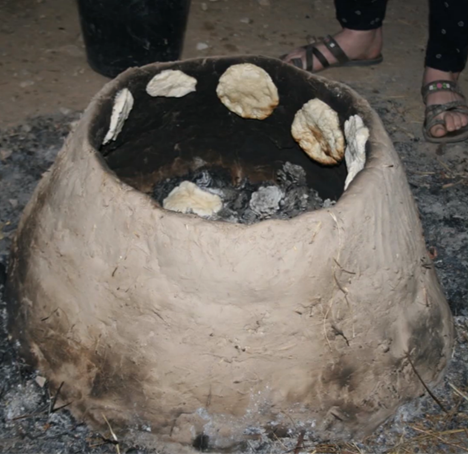

This oven is built by stacking clay or mud, creating a circular opening. Though not visible in this picture, they were usually a little larger than this, and at the bottom, there was a hole like a furnace where the wood was placed and air could pass through to keep the fire burning well.
When the fire catches, the oven heats up, and the dough is attached to the side wall, as shown in the picture, to be baked by the oven's heat. Usually, the dough is attached when the wood has almost completely burned down and the fire is about to go out. The bread is finished after the fire is extinguished. Since it is not leavened like bread, the dough is flattened and attached to the oven wall, and the flatbread is completed in about two to three minutes.
The Principle of the Oven Heating Up
The passage today says that this oven is very much like Northern Israel. And it uses this oven to communicate and emphasize two facts.
One is that when cooking begins in this oven, it does not involve placing an iron pot on top and boiling water to cook rice, as in the Korean agungi (furnace). Instead, it begins by putting wood in and stoking the fire all night to raise the oven's temperature. They put in wood and just burn the fire, doing nothing else. Heating this oven to make it hot is a very important part of today's passage. Therefore, the core point of the oven analogy in this text is how this oven is heated up to prepare for cooking.
What Makes Our Hearts Hot
We sometimes lose our temper suddenly, say hurtful things, and unintentionally wound others. We think this action was not our true intention, and we apologize to the person, saying it was not what we truly meant.
However, the Bible speaks of this tendency in us this way: when words and actions emerge from within us, it is like something that naturally bursts forth from a state of heat, like an oven that has been heated for a long time by constantly adding wood. It explains that desires accumulate and accumulate, and the heart becomes hot and hot with that desire, and then the words come out.
This is the expression: If we begin to move away from God's word and grace, we start to fuel this oven with the world and worldly desires.
Originally, we should be igniting the fire with God's grace and word to warm the oven. But what happens if we continuously push away God's word and keep our distance? Not approaching God's word does not merely mean departing from it; it means that from that moment, the world and countless worldly things begin to burn in our hearts.
All night long, the oven in our hearts continues to stoke the fire with these worldly things. The phrase 'stoking the fire' means to keep it awake. It means to keep the fire from going out, to keep it awake. That is, we bring fuel and put it in so that the fire does not go out and continues to burn.
Originally, we should be using godliness, holiness, love, the word, or patience as fuel to burn. But the further we get from God, the less sensitive we become to the word. The more we focus on ourselves, the more we begin to burn the wrong kind of fuel. And there is so much of that worldly fuel that we do not even need to deliberately search for it. We do not need to study hard to know it.
You know the names of those fuels all too well, don't you? We use the fuel of anxiety whenever we want. We become anxious at the slightest difficulty or hardship. We too easily bring and burn the fuel of nervousness. But there are countless more frightening fuels. There is the fuel of envy toward others, and the fuel of hatred. With so many of these fuels, we have been slowly heating our oven for a long time.
As we began to drift away from God, small things one by one started to enter the furnace of the oven. Sometimes, hatred for a neighbor, which seems like nothing, unknowingly enters and begins to burn. But we do not realize at all that we are using the wrong wood to light a fire, that our heart is getting hot, and that our lips are being stained with lies. This is because this oven is heating up slowly, so we do not easily notice it. Unconsciously, we throw in pieces of envy, jealousy, dissatisfaction, and all the things, all the desires around us, one by one.
The Sudden Manifestation of Sin's Fruit
In this way, the hearts of Israel and our own hearts have become as hot as they can be, burning with the wrong things. This is the first meaning the oven analogy in today's passage wants to convey to us.
When the owner puts the dough into that hot oven, the bread comes out in less than two minutes. This is the story of the second analogy presented in the passage today.
The first analogy suggests that a long time has passed without our knowing it. Without our realizing that we were drifting away from God, our desires and self-centeredness were constantly fueling this oven. These are the fuels of the world. We ourselves did not know that such things would be used as fuel. We thought we were just momentarily cursing or hating someone without thinking, but you will suddenly realize one day that those things had become fuel and were creating a hot oven in your heart.
Words that I did not intend or consciously think about suddenly leap out, and a knife that hurts the other person is hidden in those words. Of course, the speaker might have meant well. We generally think the other person simply misunderstood. But that is not the case. Our heart had already burned so much of this fuel without our knowing it, and our oven was as hot as it could be. We were just unaware that the fire was escaping outward. This is because we thought everything that came out of our mouths was born of good intentions.
We make excuses that it was not our true intention, but the hot oven that had been burning all this time was already in our hearts. In that oven, all our sins, desires, prejudices, and many other worldly things had been burning. As a result, the hot intensity remains intact in the words we utter and in our lives. That is why today's passage clearly tells us:
It waits until that moment. Until it bursts out, until that heat devours others. And then, the passage says, the dough is put in and quickly becomes bread. This means it is not a sudden slip of the tongue. We think it is, we think we made a bad judgment because we couldn't overcome a momentary desire, but in reality, we had been continuously heating the oven. In fact, our heart was constantly catching fire, and we were heating the oven all night long. The fuel was constantly being supplied.
Our ambition, greed, hatred, envy, jealousy—all these things, the gossip and all the thoughts we harbored in our hearts, the time we did not spend close to God, and the many things we did thinking about ourselves instead of the Lord—these are the actual fuels for this oven.
Then, when it suddenly appears as bread, we all think the bread is the problem. We easily make excuses like, 'This bread is wrong; I should have kneaded the dough better; I should have added a little more yeast; I need to use better flour.'
That was the method Israel used. What did Israel think? They thought, 'All of this is the king's problem.' So, they decided to kill the king. Over 40 years, they assassinated the king no fewer than four times. As a result, the person who reigned the longest only lasted ten years. Yet, nothing changed. This is because it was not just the king's problem. The problem does not disappear simply because the king is changed or removed. This is because it was not only the king's problem.
If you are currently facing a spiritual problem, or if you feel something boiling up inside you and you are distressed because of it, the story of this analogy will make you think about many things. You will reflect: 'What kind of oven did I have, and what was I using as fuel? Was I truly living a life drawing near to God, or was I perhaps too easily thinking that I was doing well enough in my faith by just not doing bad things in the world and not harming others, even while drifting away from God? Was it possible that countless fuels were burning without my knowledge?'
The Core Issue: Not Crying Out to God
Therefore, in verse 7, the passage expresses what the true core of the problem is:
Let us read verse 7 together.
“They are all hot as an oven, and they devour their judges; all their kings fall, and none among them calls upon me.”
Here, 'judges' actually refers not only to those who preside in court but also to governing officials, so it can be understood as 'leaders.' The English Bible often translates it as 'Ruler.' It means they overthrew and killed all the kings. However, far from solving the problem, they missed the real core of the issue.
You did a righteous thing. It was not wrong. You thought the problem would be solved if you changed the wicked king. You thought all problems would be solved if you quickly drove out the judges who made poor judgments.
This is not merely talking about general societal issues; it is an attempt to deal with the spiritual warfare taking place in our hearts on a much deeper level. We think that by eliminating or suppressing the wrong things we see, or by avoiding them, the problem will be resolved. But that is not the case.
The real problem is not that the things they did were wrong or incorrect, but that no one, absolutely no one, cried out to God about the problem.
Friends, I worry that when the phrase 'crying out to God' appears, you might simply understand it as praying aloud to God. I am concerned that you might think your prayer was insufficient, so you simply need to pray to God to solve the problem. Today's passage is not just about prayer. While praying is a good and natural action, not praying is not the fundamental issue being addressed in this passage.
The Pursuit of Excellent Christian Living
I would like to elaborate on this point. It is not wrong to want and seek a king who governs righteously and devoutly. However, not only the king but all believers must also pursue a life of excellence in their own lives.
In whatever work we do, we must make our best effort with the talents God has given us, and it is not a problem at all to try to achieve results that please God through what He has provided. Using the gifts God has given to do our best—that is the work the Bible guarantees, saying, "Do it with all your heart."
You and I should aim to hear the words, "Indeed, Christians are truly faithful," and we are people who must earn this recognition from the world. Although this is a difficult thing to hear and receiving praise from everyone is nearly impossible, you have the undeniable responsibility to do your best in your own field. Every person who seriously strives to fulfill their God-given mission, whatever their work, deserves thanks, respect, and honor.
Even if church workers fail to execute their duties properly or lack ability, while they must correct themselves and listen to others' opinions, if we can see even a little of the effort they are making to do their best in God, we should naturally respect them.
Is this only true in the church? It is the same in the family. Where can a husband or wife find a perfect spouse? Yet, if they are clearly striving and working hard for the family as a wife and husband within the home, we must naturally show them love and respect. For the husband and wife who are struggling and working hard to protect their family, even if they are lacking, it is entirely natural for their spouse and family to have respect and honor for them.
This is not just an issue between spouses. It applies equally to children. Even if they are immature in various ways, their actions and words are inadequate, and they seem very young to their parents, if the parents know that their children are trying to follow their path with a heart of respect and love for their parents, it is right to respect the children. If our children are doing well, we should show them sufficient praise and respect so that they are not provoked.
If you do not do that, it is not simply poor child-rearing or raising the children incorrectly—it is committing sin. You are walking the path of a sinner before God. If you do not respect that child and do not celebrate and respect them with the word of God so that they are not provoked, you are committing sin before God. It is something that requires repentance and turning back. God is not pleased. If you have made such a mistake with your children, our Christian family duty and characteristic are to ask for their forgiveness and to reconcile and unite hearts again.
We endlessly forgive, accept, and love one another. This is because we are connected through Jesus Christ. We are still insufficient to accept everything just by looking at them, and they are still insufficient to forgive everything just by looking at us. But what we clearly know is that through Christ, we must show each other the respect and love that is our duty.
What Should We Rely On?
In reality, however, we cannot always be excellent and do well. Therefore, we expect our children to change first, and many people even fight with their children and scold them to fix them.
It is not exactly the same as blaming the king and leaders, but similarly, we make the mistake of blaming our children. We think it is natural and easy to say, 'Hey, what haven't I done for you? Mom and Dad didn't have this or that when we were young.' It is not a wrong thing to say, after all.
However, many of you have come to realize that this thinking is wrong. Therefore, you have come to know that if a child has a problem or difficulty, it is also your problem. Seeing that child with a problem, you also see who you are, accept it as your problem, and worry about the issue together with the child.
But today's passage tells us to take one more step forward from here.
The Bible shows us what we should rely on when we face problems and difficulties within the family—issues with husband and wife, children, and all the hardships and problems that arise among members of the church and in the many ministries within the church. God wants us to realize the truth that 'I had forgotten God, I hadn't sought God, and I hadn't cried out to God,' and to turn back.
In many cases, the reason children struggle is because of the parents' desires. The parents wanted something and want their children, their other selves, to reach that position. The greed of the parents causes such problems. And it takes a long time to give up this work. So, if greed is the problem, will cutting out the greed solve all problems? The Bible says no. The simple determination, 'From now on, I will abandon all desires and simply treat my child purely,' is not enough.
Instead, the Bible says we must now truly seek God and long for Him, and recognize and admit the fact that the world is becoming our god right now. Without our knowing it, our oven was on fire, and many worldly fuels had been put in. Worldly desires were burning, they began to take root in us, and so, without our knowing it—even as we thought we were diligently living the faith, thought we were living according to God's word, and sometimes thought we were giving all our strength for the Lord's word—in that very moment, we were actually continuously burning our worldly desires through the back door and heating the oven.
Therefore, it is not surprising that things that hurt others and distress the community come out of the mouths and lives of people who seem to have such good faith, are diligent in prayer, and serve the church wholeheartedly. This is because we are completely unaware of the process by which that oven heats up.
Look Back at Your Oven
Therefore, I urge you not to easily dismiss this warning from the Bible but to once again deeply look into our oven.
'What am I burning right now?'
'Am I truly burning God's grace, or am I unknowingly creating an oven that is being heated by the things of the world?'
Friends, one of the people most fearful of this warning from God is me. Because of my position as a pastor, it is easy to think that my oven is always safe. I think that since I am preaching the word, meditating on the word, and close to the word, my oven is naturally safe. However, I might not know that the back door is wide open, that hatred has entered, that arrogance has entered, or when the desire to exalt myself has crept in. In the meantime, my oven has become hot, and a single word of mine, which I did not think would be hurtful, ends up hurting some people.
Therefore, I hope this word will be a precious word for you, but it is also a word desperately needed by me and all who preach the word.
The Next Analogy: The Unturned Cake (Flatbread)
The second analogy presented in the text is about the unturned flatbread. We will discuss what this means and points to in more detail next week.
However, as we conclude today's message, I want to briefly explain why the unturned flatbread suddenly appears after the story of the oven. The passage says it is because Israel is serving themselves instead of God. It expresses it this way:
"Israel, because you are mixed with the nations, you are like an unturned cake (flatbread)."
Here, being 'mixed with the nations' does not mean that they entered into marriage with foreigners, which God dislikes.
It means that they have idols, rather than only serving God. The most fundamental form of that idol is ourselves. Serving yourself does not mean you are not praying to God; it means you are serving yourself more. It does not mean you are not worshiping. Let me be more precise: it does not mean you are not worshiping sincerely or not singing praises with all your might. The Bible says that such fervor cannot be the trace or sign of your faith, nor can it be the definitive standard by which your faith can be known. This is what is likened to the unturned flatbread in today's passage.
To express it using the Book of Revelation, it is the Church of Laodicea. You may remember the phrase 'neither cold nor hot,' but the truly important statement is this: 'They think they are rich, but they are poor and naked.'
Friends, the Book of Hosea is a prophetic book. It is full of uncomfortable words for our hearts and minds. However, the reason God always conveys this to us is that you can fight against it, you must leave those things, and you can walk a different path in your life through the grace of God.
Friends, look back at your oven once again. And look once more at what you are relying on. What are you burning in that oven? What did I burn for my life this past week? What fuels did I bring and put in? Was it only my anger, my dissatisfaction, my fear, and self-pity?
Or was I trying to draw near to God's word and near to the Lord's grace, with the confidence that even amidst all these things, there is one who loves me, there is one whom I can rely on, there is one who wipes my tears, and in the midst of all that anger, pain, and my wounds, Christ is my fuel—Christ who binds me up, calls me, and enters the fire with me to burn all those things together? You must check whether your life, which is in the Lord, is truly your fuel. May your life be filled with true comfort and genuine joy this week.
Let us pray.
Loving Lord, we see ourselves—yes, I see myself—too easily trying to pass off our actions as merely a mistake, as not our true intention when we spoke. Lord, forgive me. Lord, help me to realize. Help that sin to find me. Please show me who I am.
Grant me to truly realize that sin before You, to turn back to You, and to know what God's grace is, and to find strength again in that grace. How can our hearts and lives be twisted? How can we lose joy? How can we live in pain? How can we, who are in God's grace, end up only in suffering? End up in tribulation?
If it is our character to rejoice in tribulation and praise the Lord in the midst of suffering, Lord, help us to look back again and realize what our oven is burning. We pray this in the name of Jesus Christ. Amen.
'II. Pastor's Sermon Collection > Hosea' 카테고리의 다른 글
| Hosea 12 – The Dove and the Bow (0) | 2025.11.07 |
|---|---|
| Hosea 11 – The Half-Baked Bread (0) | 2025.11.04 |
| Hosea 9 – What Shall Be Done? (0) | 2025.10.19 |
| Hosea 8 – I shall live before Him (0) | 2025.09.30 |
| Hosea-7-True Diagnosis, False Remedy (0) | 2025.09.26 |